
Memorization almost seems to be a lost art. Why learn your friend’s phone number when you can just save it as a contact in your phone? Who needs to memorize the periodic table of the elements when you can just Google it? Why memorize a Bible verse when you can just whip out your phone and search for it?
Digital media has rewired our brains and now as AI seeks to transform the world as we know it, memorization and its brain-boosting powers seem more important than ever. Perhaps one of the most important and counter-cultural tools we can give our children as we raise them in this environment is to have them memorize information and learn to do things the analog way. Give them skills that will serve their learning journey well and help their brain development.
While memorization in general is an excellent skill, memorizing Scripture is even more important. The Psalmist tells us in Psalm 119:11 “I have stored up your word in my heart, that I might not sin against you.” Memorizing Scripture is beneficial for brain power, but it’s vital for the Christian life if we want to grow spiritually. It enables us to learn who God is, discern how he wants us to live, grasp his word so we can obey it, resist temptation, and so much more.
As a parent, I want to help my children memorize as much Scripture as they can. Yes, it’s good for their brains, but I also want it to sink deep into their hearts. I want it to be woven into the fabric of their lives so tightly that it comes out when they need it – consciously or not! The writer of Hebrews tells us God’s word is “living and active, sharper than any two-edged sword, piercing to the division of soul and of spirit, of joints and of marrow, and discerning the thoughts and intentions of the heart.” (Hebrews 4:12 ESV) God tells Isaiah that his word always has intention: “For as the rain and the snow come down from heaven and do not return there but water the earth, making it bring forth and sprout, giving seed to the sower and bread to the eater, so shall my word be that goes out from my mouth; it shall not return to me empty, but it shall accomplish that which I purpose, and shall succeed in the thing for which I sent it.” (Isaiah 55:10-11 ESV) Memorizing Scripture isn’t just storing data. It has a holy aim and I want it at work in the lives of my children.
Modern society and the education system in general often sell children short when it comes to memorization. We don’t give them enough credit for what they are capable of, particularly in the younger years. Children can memorize information so quickly! I learned this firsthand myself several years ago when my daughter entered a new class in the church nursery at 2.5 years old. I received a list of 26 verses for her to memorize from Songs for Saplings ABCs and I thought, “Really? You expect my 2-year-old to learn this and recite/sing it to you?” Even though the verses were short or simplified, I doubted that she was capable of what seemed such an ambitious project. Despite my reservations, we launched into learning them. My daughter soaked up those catchy little tunes and learned each week’s song in no time flat. I stood corrected.
I think adults, myself included, often project our struggles with memorization onto our children, when they are at the prime age to memorize and store up knowledge they can tap into later in life. Don’t sell your kids short!
Song is a powerful tool
One of the best ways to begin Scripture memory with children is to employ the use of song. As I hinted above in referencing my daughter’s memory verse program, songs are one of the easiest ways to learn anything – even as adults! We do this all the time without realizing it. All it takes is hearing a line of a song – or something that reminds us of song lyrics – and the rest of the song starts playing in our head. A company logo may be enough to send the jingle from an ad running through your mind. Music is an excellent way to memorize Scripture and have it stick.
To this day, many of the verses I remember the most clearly are Scriptures I learned as songs as a child. I learned The Lord’s Prayer and the books of the Bible to music and I can still sing those songs today, decades later.
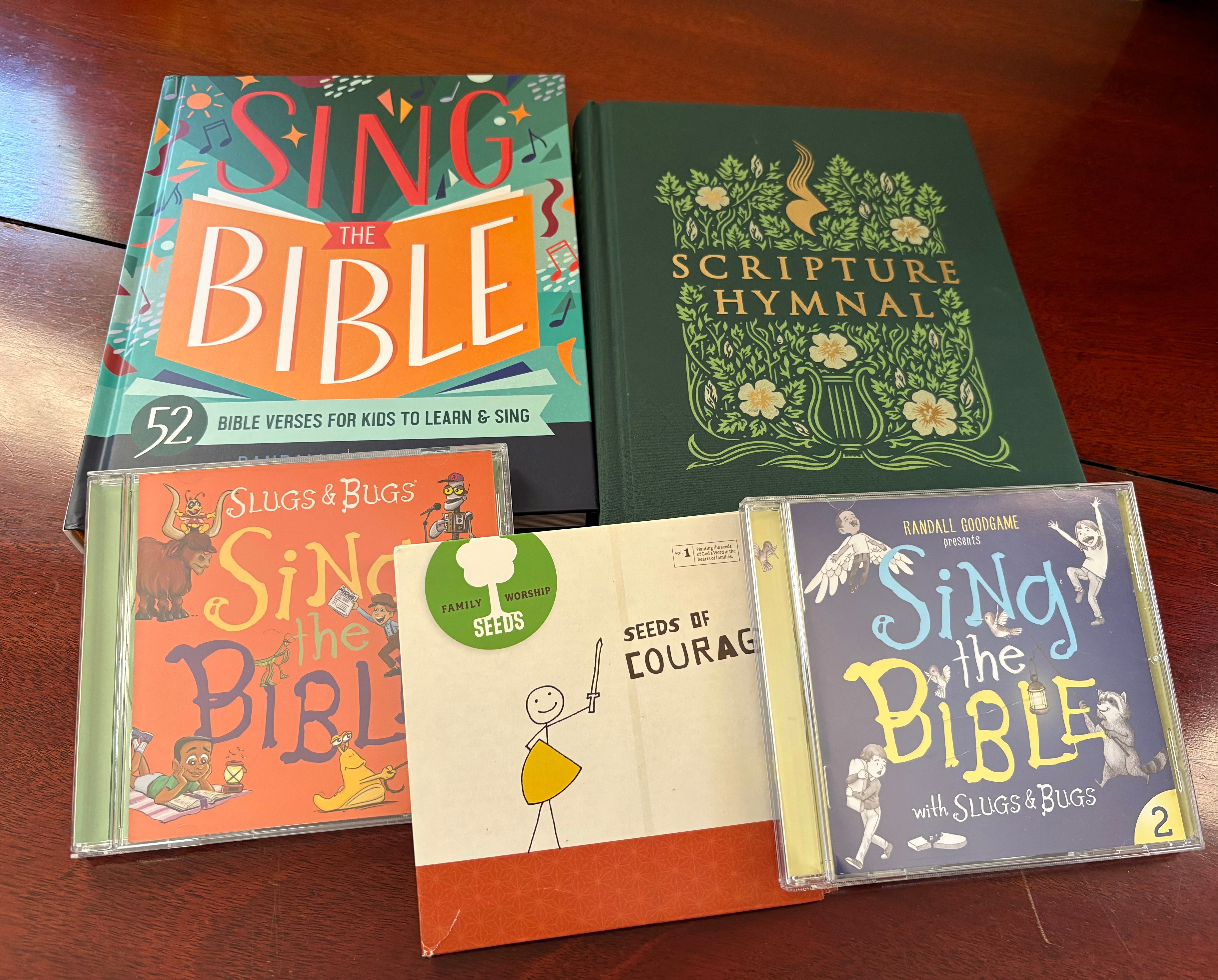
This generation of parents is blessed to have an abundance of Scripture music resources available to access easily. A beautiful added benefit of listening to songs with your children is you will learn them, too! A few of our family favorites include Sing the Bible with Slugs and Bugs, Scripture Hymnal, The Corner Room, Songs for Saplings, and Seeds Kids Worship. Scripture Lullabies is also a great option, although not all of the songs are Scripture verbatim. As the name implies, these peaceful arrangements make great lullabies or music to listen to when trying to encourage a calmer atmosphere.
Attach memory work to another habit
Another way to work on memorizing Scripture is to attach practicing verses to another habitual task. Add in memory work at a meal, while your children are getting a bath, in the car, or during family worship. There are many options for each family. Choose one that works best for you, and don’t be afraid to try something else if the first option doesn’t prove to be a good fit. In five minutes, you could run through a verse a few times and then move on. It doesn’t have to take a lot of time or effort, although it does require intention. In my family, we use a few options. We homeschool, so I include memory work in our daily schoolwork, but we also listen to Scripture set to music in the car, and recite them around a shared meal. The latter two allow my husband to be involved as well.
Write it down
If your children are old enough to read and write, have them copy the verse repeatedly. Writing is a powerful tool for learning. If you’re homeschooling or just trying to help a child improve their handwriting, a weekly memory verse also makes a great copywriting exercise.
Try a first letter challenge
Another popular modern memorization tool is to write down the first letter of each word in the verse. Then have your kids challenge themselves to see if they can remember which word the letter represents. For example, if memorizing Psalm 23:1, you would write down, TLIMS; ISNW, then work to remember, “The Lord is my shepherd; I shall not want.” (ESV) This is a great tool for adults, too. I’ve used it personally and found it helpful. Since my children are early elementary, we haven’t tried this one yet with them, but it could work well with older children.
Review verses they’ve already learned
Every once in a while, run through the verses you’ve already learned to help them stay fresh. If you’re working on a verse daily, then maybe after each session of working on a new verse, you could ask your children to recite one they’ve learned previously and cycle through them. Songs are a lot easier to store in our brains without lots of repeated revisits, but if you’re memorizing in another way, periodic review is helpful. This is admittedly an area in which I need to be more consistent.
Discuss each verse together
Rote memorization isn’t the goal. It’s important to discuss each verse with your child to help them understand the meaning of the verse, its context, and how it applies to their lives. Memory verses can also be a good tool for parenting. When trying to help correct sinful behavior and offer an alternative, you could use a Scripture verse your child has memorized to help them see how God wants them to live and how God’s grace helps us to do so. For example, my husband and I have often leaned on Ephesians 4:32 to help gently remind our kids to be kind to one another and forgive each other.
Ultimately, the most important thing to remember while helping our children memorize Scripture is that it doesn’t save them. They can memorize entire books of the Bible, but unless the Holy Spirit is working in their hearts, they will miss it all. Scripture memorization is an important tool in our job as parents to help raise our children in the Lord and expose them to the gospel, and I believe it’s an endeavor that’s well worth the effort, but the results are entirely up to him. Seek to help your child learn God’s word and pray it will bear good fruit in their life.


 Liz Parkhurst
Leave a comment